Automating Tech Support Through AI and Anti-Detect: Building a Support Account Farm
Ready to protect your online identity?
Choose your plan and start running undetectable browser profiles today.
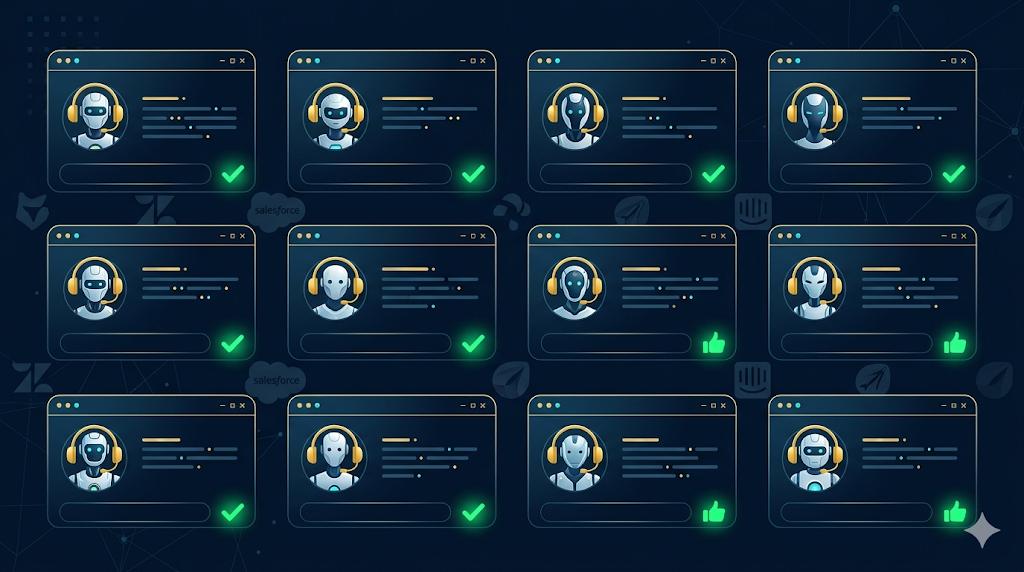
Running customer support at scale across multiple platforms has historically required either a large headcount or accepting degraded response quality. The emergence of capable language models combined with mature anti-detect browser infrastructure has created a third option: automated support account farms that can maintain dozens of simultaneous identities across Zendesk, Freshdesk, Intercom, Help Scout, and platform-native support systems, all coordinated by AI response generation with minimal human oversight.
This is not a theoretical capability. Operations of this type are running in e-commerce, SaaS, crypto exchanges, and affiliate businesses where response volume exceeds what small teams can handle manually. The technical architecture is more nuanced than people expect, and the failure modes are instructive.
Why Multi-Platform Support Farms Require Anti-Detect Infrastructure
The naive approach to automating support across platforms is to use official APIs. Many support platforms expose APIs for ticket management, message sending, and status updates. This works until you hit the constraints that matter in practice.
API access requires legitimate accounts with verified business credentials. Platforms share fraud signals — an account flagged on one major support platform propagates risk scores to others that use the same fraud network. Rate limits on APIs are often more restrictive than what a human agent could produce. And critically, some platforms that businesses want to operate on do not have APIs at all, or throttle API access to the point where it is useless for high-volume operations.
The solution is to operate browser-based automation against the web interfaces of these platforms, using accounts that appear to be normal human operators. This is where anti-detect infrastructure becomes necessary.
Each support identity — let us call it an agent persona — needs to exist as a distinct entity in the fraud detection systems of the platforms it operates on. That means a unique browser fingerprint, a consistent IP address from a residential source matching the persona’s declared location, a persistent session history that shows normal working hours and behavioral patterns, and account credentials that have been warmed up over time before being put into production use.
Anti-detect browsers provide the profile isolation that makes this possible. Each agent persona lives in its own browser profile with independent cookies, localStorage, cached data, fingerprint, and proxy assignment. From the platform’s perspective, each persona is a different person using a different computer in a different location.
The AI Layer: Generating Responses That Pass Human Review
The anti-detect infrastructure handles identity isolation. The AI layer handles content generation. Getting this right requires understanding what kinds of responses these systems need to produce and what failure modes look like when they do not.
Tone and style consistency per persona is the first requirement. If an agent persona has been responding to tickets in a specific voice — slightly formal, always using the customer’s name, signing off with a particular phrase — the AI system needs to maintain that style consistently. A sudden shift in response style is a signal to experienced platform moderators that something changed about who is writing the responses.
The practical implementation uses persona-specific system prompts that define communication style, terminology preferences, response length norms, and escalation behavior. These prompts are treated as first-class configuration, versioned alongside the account credentials they correspond to.
Knowledge base integration determines response quality more than model choice. A large language model without access to current product information, pricing, policy details, and known issue lists will hallucinate answers that frustrate customers and create escalations. Effective implementations connect the AI layer to a retrieval system that pulls relevant documentation before generating each response.
The retrieval step matters even more for platforms where the support farm operates on behalf of a third party — an agency running support for multiple client businesses. Each persona needs to be contextualized for the right client’s product set so that it does not give a customer response referencing the wrong product documentation.
Escalation routing is where AI support automation most often fails in practice. Not every ticket should be answered by the AI layer. Tickets involving billing disputes, legal threats, media inquiries, major technical incidents, or emotionally distressed customers require human judgment. A well-designed system classifies incoming tickets before routing them — high-confidence, routine tickets go to AI response generation, complex or sensitive tickets are flagged for human review.
The classification step uses a combination of keyword detection, sentiment analysis, and a topic classifier trained on historical ticket data. The threshold for escalation should be conservative — it is better to escalate too many tickets than to have the AI send an inappropriate response to a customer who is threatening legal action.
Session Uniqueness: Preventing Cross-Account Contamination
The most common technical failure in multi-account support farm operations is cross-account contamination — where actions in one account session leak information into another. This happens more easily than operators expect.
Shared cookies and storage are the obvious risk. Anti-detect browsers handle this by maintaining completely separate storage for each profile. But operators sometimes create new profiles by copying an existing one without understanding that cached authentication tokens in the copied profile may link back to the original account.
IP address reuse is subtler. If two personas share the same proxy, and the platform correlates activity by IP, it may infer that the two accounts are operated by the same person. Even if the fingerprints are different, the IP overlap is a strong signal. Residential proxy pools must be allocated such that each persona has a dedicated IP or, at minimum, an IP that is never shared with another persona on the same platform.
Behavioral timing correlation is an overlooked contamination vector. If all your agent personas start responding to tickets at exactly the same time — because your automation system polls for new tickets on the same schedule — the platform can observe that all these “different” agents become active simultaneously. Introducing jitter in polling intervals and staggering activity windows across personas helps break this correlation.
Device consistency over time matters for long-running operations. An agent persona that has been active for six months should not suddenly change its user-agent to a new browser version on a specific date. Real users upgrade browsers gradually and not all at the same time. Managing browser version updates in your anti-detect profiles should be gradual and staggered, not applied uniformly across all personas at once.
Platform-Specific Considerations
Different support platforms have different detection approaches, and your operational practices need to adapt accordingly.
Zendesk uses both client-side fingerprinting and server-side behavioral analysis. They are particularly sensitive to response rate — if an agent produces responses faster than a human typist could manage, it flags behavioral anomalies. The practical solution is enforcing minimum response delay calibrated to the length of the response being sent, simulating typing speed even though the content was generated instantaneously.
Intercom employs persistent device identification that goes beyond cookies, using a combination of canvas fingerprinting, font metrics, and hardware sensor data available through the browser. Anti-detect browsers that properly spoof these signals are necessary; lightweight header-only solutions will fail.
Platform-native support systems — particularly those built into major e-commerce platforms like Shopify, WooCommerce, or Mercado Libre — tend to have less sophisticated detection than dedicated support software, but they have stronger account linkage. If multiple accounts on the underlying platform share support staff, that linkage is tracked at the account level, not the support session level. The anti-detect infrastructure needs to cover not just the support interface but the broader account presence on the platform.
Monitoring and Incident Response
A support farm is a live operation, and things go wrong. The monitoring layer needs to detect problems before they cascade.
CAPTCHA appearance is the most common warning sign that a persona is under suspicion. An automated system that encounters a CAPTCHA needs to either route it to a human solver, pause the affected persona’s activity and rotate to a fresh session, or trigger a full profile assessment. Attempting to push through CAPTCHAs with automated solvers while continuing normal operation is a common way to accelerate an account ban.
Response latency changes from the platform can indicate server-side throttling. If a persona’s API calls or page loads start taking significantly longer than baseline, it may indicate that the platform is queuing requests from that account more aggressively. Backing off and reducing activity rate is the appropriate response.
Account health metrics should be tracked per persona — response volume over time, escalation rate, customer satisfaction signals where available, and any platform-generated warnings. A persona with declining metrics should be reviewed before it hits the threshold that triggers platform action.
Periodic profile rotation is good practice even for personas that have not shown signs of suspicion. Long-running profiles accumulate behavioral history that may eventually become distinguishing. Rotating to fresh profiles on a schedule — while migrating conversation history to maintain continuity on active tickets — is analogous to credential rotation in security operations.
The Economics and Ethics Framing
The case for this type of infrastructure usually comes down to economics. A team of five human support agents can handle perhaps 50-100 tickets per day per agent at quality levels that pass platform scrutiny. An AI-backed automated system with proper anti-detect isolation can handle orders of magnitude more volume, with response quality that is often higher on routine ticket types because the AI is never tired, distracted, or inconsistent.
The ethical considerations are real and context-dependent. Legitimate business automation — a company running its own customer support more efficiently — is clearly within acceptable use. Using this infrastructure to impersonate support from companies you are not authorized to represent, or to generate fraudulent responses that deceive customers, is not. The technology is neutral; the applications are not.
For operators building legitimate multi-platform support operations, the architecture described here is the current state of the art. The combination of session-isolated anti-detect profiles, AI-generated responses contextualized to each persona and knowledge base, and careful behavioral calibration produces support operations that are both scalable and sustainable.
Ready to protect your online identity?
Choose your plan and start running undetectable browser profiles today.
Earn 15% lifetime commission on every referral.
Become a Partner →