NFT Minting: Automating Rare Collection Purchases Through Multi-Profiles
Ready to protect your online identity?
Choose your plan and start running undetectable browser profiles today.
NFT collection drops have become among the most high-stakes, time-sensitive transactions in digital commerce. A sought-after collection can sell out in seconds, with the difference between success and failure often coming down to gas optimization, transaction timing, and — increasingly — the number of wallet addresses you can deploy simultaneously. The technical and operational complexity of running a successful multi-wallet minting operation has escalated alongside the stakes.
The Economics of Multi-Wallet Minting
Before addressing the technical architecture, it’s worth understanding why multi-wallet minting exists and what problem it solves. NFT projects impose per-wallet minting limits to create a more equitable distribution — preventing any single buyer from acquiring the entire collection supply and ensuring broader community ownership.
The economics that drive multi-wallet operations: a project that limits mints to 2 per wallet but prices the public mint at 0.05 ETH might see immediate secondary market prices of 0.5 ETH for rare traits. The 10x potential return incentivizes technical operators to deploy multiple wallet addresses, each acquiring the maximum 2 mints, turning what looks like a retail transaction into an institutional acquisition strategy.
For professional NFT operations, the minting phase is one part of a larger trading strategy that includes pre-mint research, whitelist acquisition (covered in the Discord article), rarity sniping, and post-mint secondary market positioning.
The Architecture of NFT Minting Restrictions
NFT projects use several mechanisms to enforce per-wallet limits, each with different bypass complexity:
Smart Contract Enforcement
The most robust limit enforcement happens at the smart contract level:
// Example ERC-721 mint function with per-wallet limit
mapping(address => uint256) public mintedPerWallet;
uint256 public constant MAX_PER_WALLET = 2;

function mint(uint256 quantity) external payable {
    require(
        mintedPerWallet[msg.sender] + quantity <= MAX_PER_WALLET,
        "Exceeds per-wallet limit"
    );
    mintedPerWallet[msg.sender] += quantity;
    // Mint logic...
}
This limit is enforced by the blockchain itself — it cannot be bypassed without a different wallet address. No amount of technical sophistication at the browser or application layer changes the fact that msg.sender is a specific Ethereum address.
The bypass is straightforward: use a different wallet address. Each unique Ethereum address is treated as a completely independent entity by the smart contract.
Frontend UI Restrictions
Many NFT projects enforce limits at the minting frontend rather than (or in addition to) the smart contract level. Frontend restrictions typically check:
- Connected wallet address and its on-chain history with the contract
- Browser fingerprint (to prevent the same user from connecting multiple wallets)
- IP address (to rate-limit connections per IP)
- Discord role/whitelist status (for pre-mint phases)
Frontend-only restrictions without smart contract enforcement are less robust — the smart contract can be called directly without using the frontend — but they represent a significant operational friction for operators using browser-based minting flows.
Proof-Based Allowlists (Merkle Trees)
More sophisticated projects use cryptographic allowlists to control who can mint:
// Merkle tree allowlist verification
bytes32 public merkleRoot;

function whitelistMint(bytes32[] calldata merkleProof, uint256 quantity) external {
    bytes32 leaf = keccak256(abi.encodePacked(msg.sender));
    require(
        MerkleProof.verify(merkleProof, merkleRoot, leaf),
        "Invalid Merkle Proof"
    );
    // Mint with proof verification...
}
A Merkle tree allowlist contains specific wallet addresses that are eligible to mint. Only wallets on the allowlist can participate in the allowlist phase. This makes the minting right tied to specific wallet addresses that were pre-registered — requiring the Discord whitelist acquisition work described separately.
RPA for Automatic Minting
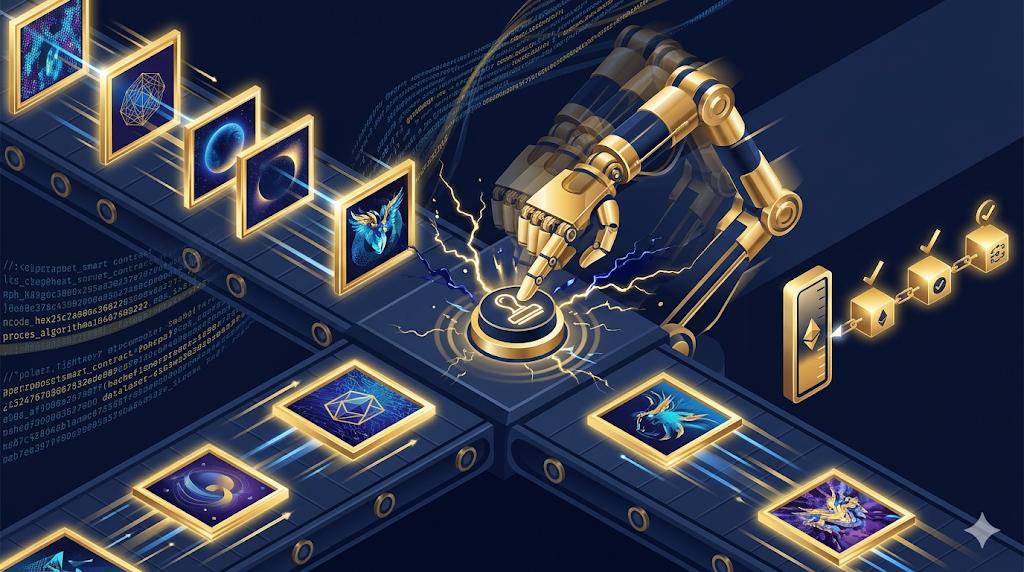
Robotic Process Automation (RPA) for NFT minting automates the sequence of actions required to complete a mint transaction within the time window of a collection launch. For popular collections, this window can be 30-120 seconds — insufficient for manually completing transactions across multiple wallet addresses.
What the Automation Must Do
A complete NFT minting automation handles:
-
Pre-mint monitoring. Watch the contract or project’s communication channels for the mint activation signal.
-
Connection sequencing. Connect each wallet address to the minting frontend in sequence (or in parallel across multiple browser instances).
-
Transaction construction. Build the mint transaction with appropriate parameters (quantity, value, gas settings).
-
Gas optimization. Set gas price and priority fee to ensure transaction inclusion within the target block. During high-demand drops, gas prices can spike dramatically in seconds.
-
Transaction submission and confirmation. Submit the transaction and monitor for confirmation.
-
Failure handling. Handle failed transactions (insufficient gas, reverted transactions, rate limits) and retry or escalate.
Browser Automation for Frontend Minting
For projects where the frontend is the required interface (particularly those with Merkle proof verification that occurs on the frontend), browser automation through Playwright or Puppeteer handles the UI interaction:
// Conceptual Playwright automation for minting
const { chromium } = require('playwright');

async function mintWithWallet(walletPrivateKey, mintUrl) {
  const browser = await chromium.launchPersistentContext(profilePath, {
    headless: false, // Some frontends detect headless mode
  });

  const page = await browser.newPage();

  // Navigate to mint page
  await page.goto(mintUrl);

  // Connect wallet (MetaMask or other wallet extension)
  await connectWallet(page, walletPrivateKey);

  // Wait for mint button to become active
  await page.waitForSelector('.mint-button:not([disabled])');

  // Click mint and confirm transaction in wallet
  await page.click('.mint-button');
  await confirmTransaction(page);

  await browser.close();
}
The key challenge for browser-based automation is headless detection. NFT minting frontends increasingly implement headless browser detection because bot activity during launches degrades the experience for genuine users. Automation must either run in headed mode (visible browser windows) or configure the browser to pass headless detection checks.
Direct Contract Interaction
For projects without frontend-only restrictions (or for multi-wallet operations targeting the public mint phase where all wallets are equally eligible), direct contract interaction bypasses the frontend entirely:
const { ethers } = require('ethers');

async function directMint(contractAddress, abi, wallet, quantity, value) {
  const provider = new ethers.JsonRpcProvider(process.env.RPC_URL);
  const signer = wallet.connect(provider);
  const contract = new ethers.Contract(contractAddress, abi, signer);

  // Estimate gas for accurate submission
  const gasEstimate = await contract.mint.estimateGas(quantity, { value });

  // Add 20% gas buffer for safety
  const gasLimit = gasEstimate * 120n / 100n;

  // Submit transaction with current gas price + priority
  const tx = await contract.mint(quantity, {
    value: value,
    gasLimit: gasLimit,
    maxFeePerGas: await getOptimalMaxFee(),
    maxPriorityFeePerGas: await getOptimalPriorityFee()
  });

  const receipt = await tx.wait();
  return receipt;
}
Direct contract interaction is faster than browser automation (no rendering time, no UI interaction latency) and doesn’t depend on the frontend’s availability during high-traffic launches. However, it requires the contract ABI and address, which are typically available on Etherscan once the contract is deployed.
Unique Hardware Configurations Per Wallet
For operations that use browser-based minting (required when the frontend is the only way to access Merkle proof minting), each wallet address should have a completely unique browser fingerprint.
Why Fingerprint Uniqueness Matters for NFT Minting
NFT project teams actively monitor for multi-wallet bot activity during launches. Projects that detect coordinated multi-wallet behavior may:
- Restrict transactions from detected bot wallets
- Revoke whitelist status for detected addresses
- Implement post-mint address banning that prevents future project participation
- Create social pressure by publicly identifying bot addresses
The signals that indicate multi-wallet coordination:
- Multiple wallets connecting from the same IP address
- Multiple wallets sharing browser fingerprint characteristics
- Multiple wallets completing mint transactions within seconds of each other
- Wallet addresses with no prior on-chain history beyond the mint
Per-Wallet Profile Configuration
Each wallet address in the minting operation should correspond to a browser profile with:
Unique canvas fingerprint. The most critical parameter — canvas hashes are commonly used in frontend fingerprinting scripts. Each profile must have a distinct, realistic canvas fingerprint.
Unique hardware profile. Different GPU claims (within realistic consumer hardware ranges), different screen resolutions, different hardware concurrency values.
Unique network timing. Connections should be spread across enough time to appear as independent users rather than coordinated bots. Even 5-10 seconds between connections significantly reduces coordination signal strength.
Separate residential proxy. Each wallet’s browser session should use a distinct residential IP address. Multiple wallets from the same IP during a mint launch is one of the clearest bot signals.
Realistic account warmup. Wallets that have been connected to the project’s website prior to launch day, that have prior NFT ownership history, and that have participated in pre-launch community activities (Discord, Twitter) appear more legitimate than freshly created wallets with no history.
Wallet Address Independence
Beyond browser fingerprints, the wallet addresses themselves must demonstrate independence:
Independent funding sources. Each wallet should be funded from a different source, or at minimum funded through different paths (different intermediary addresses). Wallets that all receive exactly the same amount at the same time from the same source address are trivially identifiable as a coordinated batch.
Funding timing variance. Fund wallets over several days before the mint, not in a single batch transaction on launch day.
Prior on-chain activity. Wallets that have prior legitimate NFT activity (purchases from secondary market, historical minting on other projects) are harder to identify as bot addresses than fresh wallets with zero history.
Different wallet software. A portfolio of minting wallets that all use exactly the same MetaMask version on the same browser fingerprint appears coordinated. Mix of MetaMask, Coinbase Wallet, and Rainbow wallet profiles adds variance.
Gas Optimization for Multi-Wallet Drops
Gas optimization is the technical differentiator between successful and failed multi-wallet minting operations. During popular launches, gas prices can spike 100x the normal rate within seconds of mint activation.
Priority Fee Strategy
EIP-1559 transactions use two gas parameters:
maxFeePerGas: The maximum total fee per gas unit you’ll paymaxPriorityFeePerGas: The tip to validators for transaction inclusion priority
For time-sensitive minting:
async function getOptimalGasSettings(provider) {
  const block = await provider.getBlock('latest');
  const baseFee = block.baseFeePerGas;

  // During launches, pay premium priority fee for fast inclusion
  const priorityFee = ethers.parseGwei('50'); // 50 Gwei priority during launch

  // MaxFeePerGas = 2x baseFee + priorityFee (covers baseFee increases for 3 blocks)
  const maxFee = baseFee * 2n + priorityFee;

  return {
    maxFeePerGas: maxFee,
    maxPriorityFeePerGas: priorityFee
  };
}
Gas Simulation Before Launch
Before a high-stakes launch, simulate the mint transaction using the contract’s bytecode (available after deployment) to:
- Verify the transaction will succeed (no revert conditions)
- Establish accurate gas estimates
- Test timing and sequencing across multiple wallets
Gas simulation with tools like Tenderly or Hardhat’s eth_call reveals issues before real funds are at risk.
Bypassing One-Mint Limits: The Smart Contract Reality
The honest technical reality: smart contract-enforced per-wallet limits are a solved problem technically — a different wallet address bypasses them — but a complex operational problem. The complexity isn’t the bypass itself; it’s building a portfolio of wallet addresses that can operate at scale while appearing independent to on-chain analysts and project teams.
Projects that issue post-mint refunds or bans to detected bot addresses are attempting to apply off-chain judgments to on-chain transactions. These judgments depend on blockchain analytics: clustering wallet addresses by funding patterns, timing, and interaction graphs.
The operational goal isn’t to make the wallets individually unremarkable — it’s to make their relationships to each other invisible. Wallets that are genuinely independent (different funding paths, different timing, different prior history) are not identifiable as a coordinated batch even if they all mint from the same collection.
This requires treating wallet management with the same operational rigor as account management on any other platform: separate infrastructure per wallet, independent funding, independent history, and disciplined timing variance across all operations.
Ready to protect your online identity?
Choose your plan and start running undetectable browser profiles today.
Earn 15% lifetime commission on every referral.
Become a Partner →