Shopee and Lazada: Capturing Southeast Asian Markets Through Account Farms
Ready to protect your online identity?
Choose your plan and start running undetectable browser profiles today.
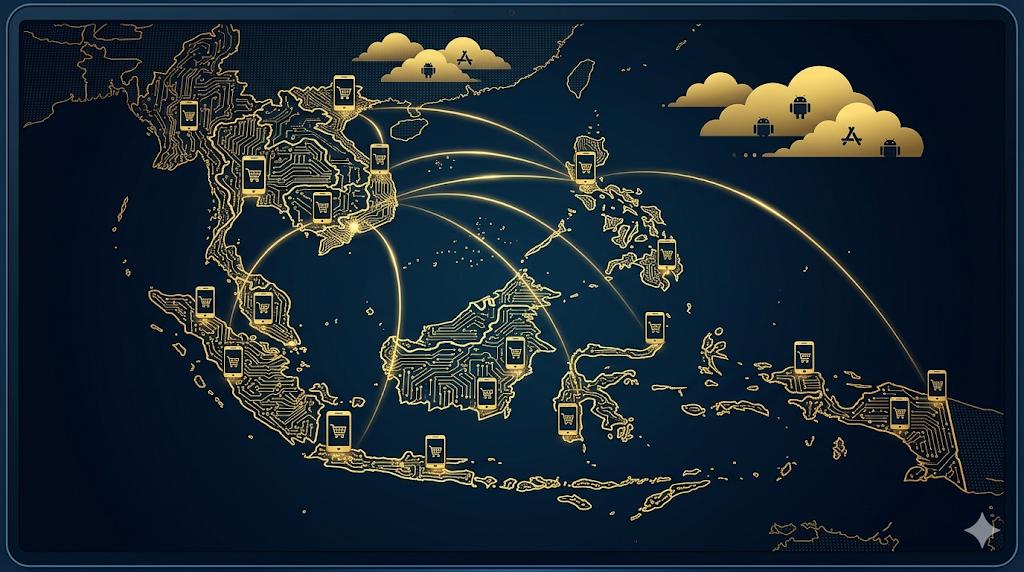
Southeast Asia’s e-commerce market is structurally different from Western markets, and those structural differences create both unique opportunities and unique challenges for multi-account operators. Shopee and Lazada together control over 70% of the Southeast Asian e-commerce market across six major markets: Indonesia, Thailand, Vietnam, the Philippines, Malaysia, and Singapore. The scale is enormous — Shopee alone processed over $80 billion in gross merchandise value in 2025.
What makes these platforms operationally distinct is their mobile-first architecture. Shopee and Lazada were designed for smartphone users, not desktop browsers. Their anti-fraud systems reflect this design priority: they are far more sophisticated at detecting mobile session manipulation than most Western marketplace fraud systems, and far less concerned with desktop browser fingerprinting.
The Mobile-First Architecture Problem
For operators accustomed to anti-detect browser approaches that work on Amazon or eBay, the shift to Shopee and Lazada requires a fundamental rethinking of the technical approach.
Why Desktop Browsers Don’t Work
Shopee and Lazada’s seller platforms have desktop web interfaces, but these interfaces are secondary. The mobile apps handle:
- New account registration with phone verification
- Phone number-linked identity verification
- In-app behavior tracking tied to device identifiers
- Payment method linking through mobile payment systems (GrabPay, OVO, GCash, TrueMoney)
- Customer communication through in-app messaging
An account created on mobile generates a device fingerprint that’s associated with that account permanently. When that account subsequently logs in through a desktop browser, the system notes the channel change but maintains the mobile device association.
Critically: new seller accounts created on desktop without prior mobile registration are flagged at higher rates. Shopee’s onboarding flow expects phone verification through the mobile app, and accounts that bypass mobile onboarding are treated as higher-risk.
The Real Device vs. Emulator Problem
The standard approach for managing multiple mobile accounts is Android emulators. BlueStacks, LDPlayer, MEmu, Nox — these are the common solutions. They work for casual use but fail for serious multi-account operations because Shopee and Lazada both implement sophisticated emulator detection.
Emulator detection uses multiple signals:
Build properties. Android’s android.os.Build class exposes dozens of properties about the device. Emulators set these to generic or inconsistent values. Real devices have properties that match the manufacturer’s specifications exactly:
// Common emulator indicators in Build properties
Build.FINGERPRINT  // Contains "generic", "unknown", or emulator-specific strings
Build.HARDWARE     // "goldfish" (QEMU) or "ranchu" (common emulator values)
Build.PRODUCT      // "sdk_phone_x86" or similar generic values
Build.MODEL        // "Android SDK built for x86" for QEMU-based emulators
Build.MANUFACTURER // "Genymotion", "Google", "unknown" for emulators
CPU architecture. Real Android phones use ARM architecture. Emulators on x86 desktops typically run x86 Android images. While ARM translation layers exist (QEMU TCG, Intel HAXM), they introduce timing differences that are detectable.
Sensor data. Real phones have accelerometers, gyroscopes, magnetometers, proximity sensors, and ambient light sensors. Emulators either provide fake sensor data with unrealistic patterns or no sensor data at all.
Telephony state. Real devices have IMEI numbers, SIM card data, carrier information, and network type indicators. Emulators typically show empty IMEI, no SIM, and no carrier data.
GPU performance characteristics. Mobile GPU rendering is distinctly different from desktop GPU rendering. Emulators using host-GPU passthrough produce timing signatures that don’t match real mobile GPU behavior.
Cloud Android: The Solution to Emulator Detection
The solution that sophisticated operators have adopted is cloud Android infrastructure — virtual Android environments that run on ARM server hardware rather than emulated x86 hardware with ARM translation.
How Cloud Android Differs from Emulation
Services like GeeLark, and similar cloud Android platforms, run Android on actual ARM processors in data centers. From the application’s perspective, this is indistinguishable from a real ARM device:
- Build properties reflect genuine ARM Android configurations
- CPU architecture is ARM64 (aarch64)
- GPU is a real mobile GPU or close hardware equivalent
- Sensor data can be configured to realistic values
- Network characteristics reflect mobile network behavior
The key detection test — checking whether the CPU’s execution timing is consistent with ARM execution or shows the translation overhead of x86-to-ARM emulation — passes on real ARM cloud hardware.
Profile Configuration for Cloud Android
A cloud Android profile for Shopee or Lazada operation needs several carefully configured parameters:
Device model selection. Choose device models that are common in the target market. In Indonesia, Samsung Galaxy A-series and Xiaomi Redmi series are dominant. In Vietnam, Oppo and Vivo are popular. In the Philippines, low-to-mid-range Samsung and Xiaomi are most common. An account operating in Indonesia that presents as an iPhone 15 Pro is unusual — Apple’s market share in Indonesia is under 5%.
IMEI and device identifiers. Each profile needs a unique IMEI, Android ID, and Google Advertising ID. These must be realistic values — IMEI numbers have a specific structure (TAC code + serial + check digit) and must correspond to the claimed device model. Android IDs are 16-character hexadecimal strings generated at device setup. Using obviously fake or duplicate identifiers is a common mistake.
SIM card configuration. Configure the virtual SIM to match the target market’s carriers. For Indonesia: Telkomsel, XL Axiata, Indosat Ooredoo. For Thailand: AIS, DTAC, True Move H. The Mobile Country Code (MCC) and Mobile Network Code (MNC) must match the target country and carrier.
Network type. Configure the connection type to reflect realistic mobile usage. 4G LTE is the appropriate baseline for most Southeast Asian urban users. 5G is appropriate for Singapore and major Thai/Indonesian cities. 3G would be appropriate for rural area accounts.
GPS coordinates. Configure geolocation to match the seller’s claimed location. Shopee and Lazada verify seller location through multiple signals, including GPS data from the mobile app. An account claiming to sell from Bangkok should consistently show GPS coordinates within the Bangkok metropolitan area.
Phone Number Strategy for Southeast Asia
Phone number acquisition is the central operational challenge for Southeast Asian marketplace accounts. Every account requires a unique phone number in the country format, and SIM registration laws in Southeast Asia are among the strictest in the world.
Real SIM vs. Virtual Number Considerations
Indonesia: Requires mandatory SIM card registration linked to national ID (NIK). This is strictly enforced. Prepaid SIMs without registration are deactivated after 90 days. Virtual numbers work for initial verification but may fail re-verification after 3-6 months.
Thailand: SIM registration required with Thai national ID or passport. Foreign tourists can register with passport. SIM registration data is shared with the tax authority.
Vietnam: Strict SIM registration with Vietnamese national ID (CCCD). Foreigners use passport registration. Virtual numbers frequently fail for Shopee Vietnam’s OTP system.
Philippines: SIM registration with government-issued ID became mandatory in 2023. Ghost numbers were purged from networks in 2024.
Malaysia: Mandatory SIM registration with MyKad or passport. Less strictly enforced than Indonesia or Philippines.
Singapore: No SIM registration requirement for prepaid cards. Virtual numbers work well. Lowest barrier to account creation in Southeast Asia.
The practical implication: building legitimate phone number inventory for Southeast Asian markets requires either partnerships with local registrants (complex, legal gray area, KYC-dependent) or SIM card farms with properly registered cards — a significant operational investment.
For scale operations, virtual number services specializing in Southeast Asian numbers remain useful for initial account creation, understanding that these accounts may require re-verification with real numbers as they age.
Shopee’s Anti-Fraud System: What It Watches
Shopee’s fraud detection has evolved significantly since Sea Limited’s US IPO in 2017. Their current system operates across several layers:
Account Clustering Analysis
Shopee’s backend analyzes relationships between seller accounts across multiple dimensions simultaneously. When multiple accounts show correlated patterns — similar listing times, similar product categories, similar price ranges, similar customer response times — they’re grouped as a potential cluster.
The key insight: Shopee doesn’t immediately ban clusters. It monitors them, particularly watching for coordinated behavior during Shopee’s promotional events (11.11, 12.12, Shopee Birthday Sale). Coordinated promotional behavior — all accounts in a cluster boosting the same products simultaneously — is the most common trigger for cluster-based enforcement.
Shopee Coins and Voucher Abuse Detection
Shopee’s loyalty currency system (Shopee Coins) and its extensive voucher ecosystem are primary targets for multi-account abuse. Shopee’s detection system specifically monitors:
- Multiple accounts using vouchers from the same Shopee Coins source
- Voucher codes claimed across multiple accounts in rapid succession
- Buyers and sellers who appear linked attempting to boost each other’s ratings
This detection is behavioral rather than fingerprint-based, making it harder to avoid through technical means alone. Each account needs to operate as a genuinely independent commercial entity.
Payment Method Fingerprinting
Shopee’s Integrated payment system ShopeePay links payment credentials to user accounts at registration. The payment method fingerprint includes:
- E-wallet account identifiers (ShopeePay, OVO, GoPay, GCash, etc.)
- Bank account details for withdrawals
- Credit/debit card BIN codes
Sharing any payment instrument across accounts is a direct link. Each account needs independent ShopeePay registration with a separate phone number, and separate payout bank accounts.
Lazada’s Approach: Alibaba’s Detection Infrastructure
Lazada is majority-owned by Alibaba, and its anti-fraud infrastructure reflects Alibaba’s decade of experience with the Taobao/Tmall ecosystem — one of the most extensively fraud-challenged e-commerce environments in the world.
Alibaba’s Risk Engine
Lazada benefits from Alibaba’s shared risk and anti-fraud infrastructure — the same platform that powers fraud detection across Taobao, Tmall, and AliExpress. This brings several detection capabilities that are more sophisticated than what Western platforms deploy:
Device fingerprint graph. Alibaba’s risk engine maintains a graph database of device fingerprint relationships. When a device fingerprint appears associated with a fraudulent account, all other accounts that have ever used a device with overlapping fingerprint elements are flagged for review.
Behavioral sequence analysis. The system analyzes the sequence of actions within sessions, not just individual actions. The order and timing of browsing behavior — how a user navigates from product search to listing to purchase — is compared against behavioral models trained on both legitimate users and known fraudulent patterns.
Cross-platform intelligence. Because Alibaba operates multiple platforms (Lazada, Alibaba.com, AliExpress, Taobao for some markets), device and behavioral fingerprints observed on one platform can influence risk scoring on others. A device known to Alibaba from AliExpress activity carries that history into Lazada.
Lazada’s Seller Verification Requirements
Lazada’s seller verification is stricter than Shopee’s in most markets, particularly for cross-border sellers. The verification flow includes:
- Government-issued ID verification (automated OCR + liveness check)
- Business registration document verification for business sellers
- Bank account verification via micro-deposit
- Video selfie matching the ID document
Bypassing any element of this flow with non-genuine documents is both legally risky and technically difficult given modern document authentication systems.
Practical Infrastructure for 20+ Accounts
For an operation managing 20 or more Southeast Asian marketplace accounts, the infrastructure requirements are:
Cloud Android instances. At minimum one ARM-based cloud Android instance per active account. For accounts that are being maintained (not actively selling), periodic warmup sessions are sufficient.
Phone number inventory. A mix of long-term registered SIMs for priority accounts and virtual numbers for new/test accounts.
Separate ShopeePay/payment registrations. Each account needs independent payment method registration. This is the operational bottleneck — it requires a registered phone number and often a local bank account.
VPN/proxy infrastructure. Mobile datacenter proxies (4G mobile proxies) provide the most authentic mobile network fingerprint. Static residential proxies work but look less authentic than mobile connections for mobile-app sessions.
Scheduling and coordination. Accounts in the same market should not perform similar promotional actions simultaneously. Build in timing variance of at least 2-4 hours for equivalent actions across accounts.
The Southeast Asian market opportunity is substantial, but the operational overhead is proportionally higher than Western markets due to the mobile-first architecture and stricter SIM registration requirements. Operations that succeed long-term are those that invest in genuine local infrastructure — real phone numbers, real ARM-based cloud Android devices, and country-appropriate payment methods — rather than desktop browser emulation dressed up as mobile traffic.
Ready to protect your online identity?
Choose your plan and start running undetectable browser profiles today.
Earn 15% lifetime commission on every referral.
Become a Partner →