TikTok Ads in the USA: Bypassing Geo-Blocks and Running Ads on White Offers
Ready to protect your online identity?
Choose your plan and start running undetectable browser profiles today.
TikTok Ads offers one of the best performance-to-cost ratios in digital advertising for reaching American consumers under 35. The platform’s algorithm is remarkably efficient at finding purchasers for the right offers, and CPMs remain significantly lower than Meta’s for many verticals. The challenge for non-US operators is that TikTok’s advertising platform has geographic restrictions that go well beyond simply blocking non-US IP addresses — they extend into device-level verification, payment instrument verification, and behavioral analysis that identifies geo-bypass attempts with high accuracy.
Understanding TikTok’s specific geo-verification methods is the prerequisite for running ads on the US platform from outside the US.
Why Standard VPN Approaches Fail on TikTok Ads
The most common mistake is treating TikTok Ads geo-blocks the same as a streaming service geo-block. Netflix geographic restrictions are enforced purely at the IP level: connect from a US IP, get US Netflix. TikTok’s advertising platform implements multiple verification layers that make IP-only bypass unreliable.
The VPN Shadow Ban
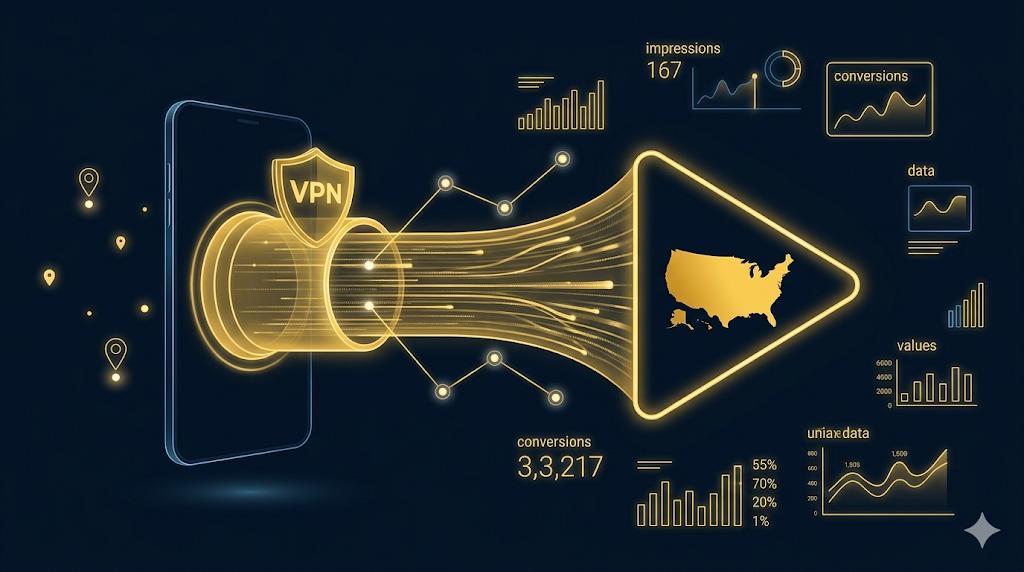
TikTok’s system maintains lists of known VPN exit nodes, including commercial VPN services, proxy providers, and suspicious IP ranges. Connecting to TikTok Ads from a flagged IP doesn’t necessarily result in immediate account suspension — instead, the account enters a degraded state where ads are “approved” but never actually receive impressions.
This shadow ban state is particularly insidious because it’s not transparent. Your TikTok Ads manager shows campaigns as active, shows budget being consumed, shows estimated reach — but actual ad delivery is suppressed or severely throttled. Operators can spend weeks building out campaigns that are never actually running.
Detecting whether you’re shadow-banned requires external verification: using a fresh US account on a genuinely clean US IP to check whether your promoted content is visible, monitoring TikTok Pixel data for impression-to-click ratios (shadow-banned accounts show zero or near-zero conversion events despite “impressions”), and checking reach estimates against industry benchmarks for your creative type and audience.
The IP Quality Score
TikTok’s fraud prevention system assigns a quality score to each IP address at account creation and at ad spend events. This score incorporates:
- IP type classification (residential, datacenter, VPN, proxy, mobile)
- IP reputation data from third-party fraud databases
- Historical account behavior associated with that IP range
- Geographic consistency between the IP and the payment instrument
Datacenter IPs score lowest. Most commercial VPN providers’ exit nodes score poorly because they appear in fraud databases. Static residential ISP IPs from the target country score highest.
Hardware and Device Verification
TikTok Ads’ account system is linked to TikTok’s consumer app infrastructure. When you access TikTok Ads Manager from a browser, the JavaScript fingerprinting system assesses whether the session appears to originate from a device consistent with a US user.
The hardware parameters that TikTok’s system evaluates include:
- Device type (mobile vs. desktop)
- Browser and OS fingerprint
- Hardware concurrency and device memory
- Timezone alignment with the IP’s geographic location
- Font set consistency with claimed OS/region
- AudioContext fingerprint
A session that presents a US IP but with non-US system fonts, a non-US timezone, and Eastern European hardware concurrency patterns is flagged. The system is trained on millions of genuine US user sessions and can identify statistically anomalous combinations.
Configuring Hardware Parameters for US Authenticity
To pass TikTok’s hardware verification, your anti-detect browser profile must present parameters consistent with a US-located user on mainstream consumer hardware.
Target Hardware Profile
US TikTok users skew toward mainstream consumer hardware:
| Parameter | US Mainstream Profile |
|---|---|
| OS | Windows 11 (40%), macOS (25%), Android (30%), iOS (5% desktop use) |
| Browser | Chrome (65%), Safari (20%), Firefox (8%), Edge (7%) |
| Screen resolution | 1920x1080, 2560x1440, 1366x768 |
| Hardware concurrency | 8-16 cores (mainstream Intel/AMD CPUs) |
| Device memory | 8-16 GB |
| GPU | NVIDIA GeForce GTX/RTX or Intel integrated |
| Timezone | US Eastern, Central, Mountain, Pacific |
| Language | en-US |
| Font set | Windows or macOS default + Microsoft Office |
Avoid exotic configurations: workstation CPUs with 32+ cores, server GPUs, or hardware configurations more common in Eastern Europe or Asia. TikTok’s fingerprinting system knows the distribution of hardware in its genuine US user base.
Timezone and Locale Configuration
The timezone must match the claimed geographic location and must be internally consistent:
// What TikTok's detection script verifies for timezone
{
  timezone: "America/New_York",           // Browser timezone
  timezoneOffset: -300,                   // UTC offset in minutes (ET)
  // Must match proxy's geographic region
  // Must match language settings
  // Must produce consistent Date() behavior
}
The timezone offset must match the IP’s geographic region. A New York-attributed IP with a Pacific time setting (UTC-8) looks wrong. A Chicago IP with Eastern time (instead of Central) creates a mismatch. Get these details right by looking up the correct timezone identifier for the proxy IP’s city.
Language settings should be en-US, not just en. The distinction matters — en without a region specifier is unusual for US users, and en-GB or en-CA immediately suggests a non-US origin.
Static ISP Proxies: The Required Infrastructure
For TikTok Ads, static residential ISP proxies are the minimum viable infrastructure. These are IP addresses from genuine residential ISPs (Comcast, AT&T, Spectrum, Verizon Fios) that are dedicated to a single user and don’t rotate.
The characteristics that make ISP proxies work for TikTok:
- ASN classification as a residential ISP (not as a hosting provider or VPN service)
- Consistent geographic attribution (IP is permanently assigned to a US city)
- No appearance in VPN/proxy detection databases
- Unique IP assignment (not shared with other users who might have flagged the IP)
Rotating residential proxies — pools where your IP changes with each connection — are less effective for TikTok Ads because account consistency relies on session-level IP stability. TikTok’s fraud system flags accounts where the geographic location varies between sessions.
TikTok Ads Account Structure for Non-US Operators
Account Creation Requirements
TikTok Ads requires for US accounts:
- US phone number (for 2FA)
- US billing address
- US payment method (US credit card or US PayPal)
- Business information (company name, website)
The payment instrument requirement is significant: TikTok verifies the billing country of the credit card against the claimed account country. A UK-issued Mastercard will not work for a US TikTok Ads account. This requires either a genuinely US-issued card or a US virtual card through services like Wise Business (US entity required) or Relay (US LLC required).
For operators without a US legal entity, the operational path is: establish a US LLC (Delaware or Wyoming), open a US business bank account (Mercury, Relay, or a traditional US business bank), obtain a US business credit card, and use these for TikTok Ads billing.
This isn’t just about fraud prevention — it’s operationally necessary. Non-US payment instruments trigger account holds within 24-72 hours of the first significant ad spend.
Ad Account Warming
New TikTok Ads accounts require a warming period before they can run significant spend:
Days 1-3: Add payment method, configure pixel, create but don’t launch one campaign with a modest budget ($20-50/day). Let it run to establish account history.
Days 4-7: Gradually increase budget. TikTok’s system flags accounts that jump from $0 to $500/day spend immediately. Gradual scaling builds trust signals.
Week 2+: Normal operation. Monitor shadow-ban signals (impression-to-conversion ratios) weekly.
White Offer Categories
TikTok’s ad review system is aggressive about content policy violations. For non-US operators using bypassed accounts, additional scrutiny applies to ad creative review. White offer categories with low rejection rates on TikTok:
- E-commerce products (physical goods, especially novelty items, fashion, beauty)
- Mobile apps (games, utilities, entertainment — not finance or health without special approval)
- Educational content
- Software and SaaS tools
- Local services (if geo-targeting is set appropriately)
Categories with high rejection rates on TikTok that increase account risk:
- Financial products (especially crypto, loans, investment advice)
- Health claims (“clinically proven,” “cure,” “weight loss guarantee”)
- Political advertising
- Adult products (even when legally sold)
Rejected ads don’t just lose money — repeated rejections lower the account’s trust score and can trigger manual review of the entire account.
Cloud Android for Mobile TikTok Ads Management
While desktop Ads Manager works for most TikTok Ads management tasks, certain operations require the mobile app: account creation on fresh devices, 2FA verification, and some review processes. Cloud Android provides the infrastructure for handling these mobile requirements without physical US phones.
GeeLark Configuration for TikTok
GeeLark and similar cloud Android platforms provide ARM-based Android environments that can be configured to present as US mobile devices. For TikTok advertising management:
Device selection: Samsung Galaxy or Google Pixel — the most common US Android devices. Avoid Chinese-manufactured devices (Xiaomi, Oppo, Realme) for US accounts — these are statistically uncommon in TikTok’s US user base.
Carrier simulation: Configure the SIM/carrier to US carriers: Verizon, AT&T, T-Mobile. The MCC (Mobile Country Code) should be 310 or 311 (US). The MNC should match the chosen carrier.
App stack: Install a US-appropriate app set. A US user’s phone has English-language apps, US App Store content, and no obvious Chinese app presence. Configure Google Play Store as the app source, not alternative app stores.
Network configuration: Route through a US 4G mobile proxy or US static residential proxy. The network connection type (WiFi vs. mobile data) should be consistent with the session context.
The Mobile-Desktop Handoff
TikTok Ads account management typically follows a workflow where:
- Initial account creation and phone verification happens on mobile (cloud Android)
- Campaign management, creative uploads, and budget management happen on desktop (anti-detect browser)
- 2FA verification when switching devices happens on mobile
The fingerprint consistency between mobile and desktop sessions isn’t automatically verified by TikTok — they’re understood to be different devices — but the IP consistency matters. Both should resolve to US IPs in the same geographic region.
Monitoring and Maintaining Account Health
Shadow Ban Detection
Monitor these metrics weekly for shadow ban indicators:
- CPM creep: Shadow-banned accounts show declining CPMs that eventually approach $0 as the system throttles delivery
- CTR anomalies: Click-through rates significantly below industry baseline (under 0.5% for most verticals) suggest delivery to bot or suppressed audiences
- Pixel events: Conversion events at a rate less than 1% of reported impressions on a well-targeted campaign is a red flag
- Reach saturation: A campaign that reports reaching 95%+ of its target audience within hours has likely been artificially throttled
Account Recovery
If an account enters a shadow-banned state:
- Pause all campaigns
- Contact TikTok Ads support via the in-platform chat (not via email)
- Request a manual review of delivery
- If delivery issues persist after 5-7 business days, consider whether the proxy IP has been flagged and rotate to a new IP before relaunching
Prevention is far more effective than recovery. Invest in clean ISP proxy infrastructure from the start rather than recycling flagged IP addresses.
The TikTok Ads opportunity for white-hat offers remains significant in 2026. The platform’s algorithm is effective, costs are competitive, and US consumer reach is substantial. But the geo-bypass challenge requires a systematic approach: ISP-grade proxies, hardware-consistent browser profiles, US-entity payment infrastructure, and cloud Android for mobile verification workflows. Shortcuts at any layer create the shadow-ban vulnerability that makes TikTok Ads feel broken when it’s actually blocked.
Ready to protect your online identity?
Choose your plan and start running undetectable browser profiles today.
Earn 15% lifetime commission on every referral.
Become a Partner →